Agentic Process Automation for MSMEs: A Practical Guide
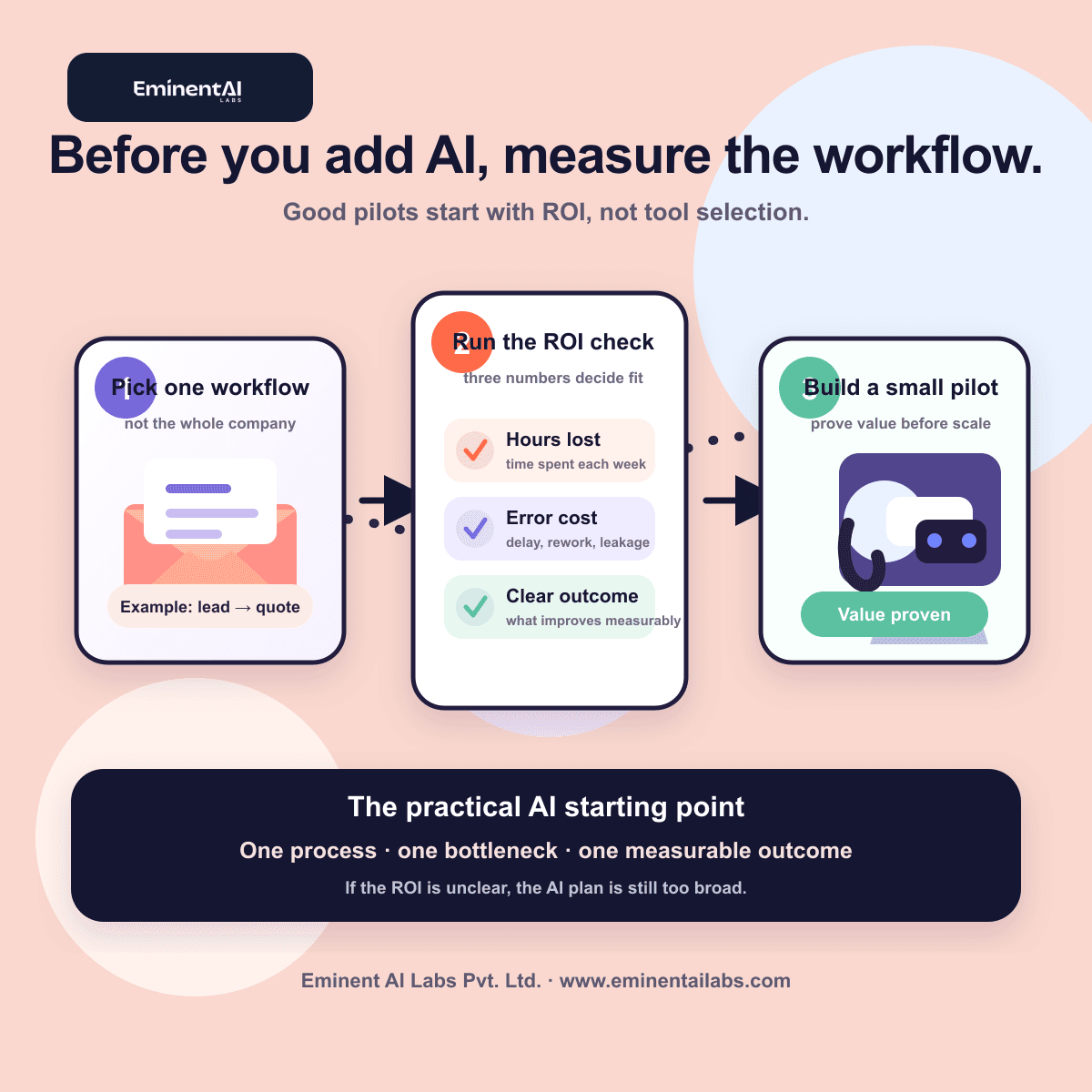
Most MSMEs don't need to start with a grand AI strategy. They need to start with a workflow that is clearly costing time, energy, or money.
That distinction matters.
A vague AI plan produces long meetings, vendor comparisons, and little business impact. A workflow first plan is different. It starts with one process, one measurable problem, and one pilot that can prove value in weeks, not quarters.
This guide is for MSME founders, operations heads, and product leaders who know they need to do something about repetitive work but aren't sure what agentic process automation actually means in practice. I'll cover what it is, how it differs from the RPA your vendor has been pitching for a decade, where it pays back first, and the right way to run a single pilot before you commit to anything bigger.
Why workflow first beats vague AI strategy
When teams talk about AI in operations, the conversation usually starts too high level:
- "We need AI in operations."
- "We should automate our business."
- "Can we use an agent for this?"
Those questions aren't wrong, but they are too broad to produce useful decisions.
A better starting point:
- Which process is creating the most friction this week?
- How many hours does it consume?
- Where do delays, mistakes, or missed follow ups actually happen?
- What would "better" look like in practical terms, hours saved, errors reduced, response time cut?
If you can't answer those, the project is not ready yet, and no tool will rescue it.
Workflow first AI works because it forces specificity. You are not buying "AI" as an idea. You are solving a real business problem with a measurable cost. At Eminent AI Labs, this is the framing we use with every MSME we work with. Our Business Process Automation pillar has the broader capability set if you want to see what that looks like in production.
What "agentic" actually means, and how it differs from RPA
A lot of AI language is vague. So let me keep this simple.
Traditional Robotic Process Automation, or RPA, is rule based. A bot follows a fixed script: open this screen, click here, copy this field, paste there. It works well when inputs are predictable and the path is linear. It also breaks the moment an exception shows up, which is most of the time in real businesses.
Agentic process automation is different. The system doesn't just generate text or classify data. It takes action across steps in a workflow: read an input (an email, a form, a document, an event), decide what happens next based on rules and context, move data into the right system, trigger the next step, and keep the process moving without a human watching every step.
The goal isn't to remove people from the process. The goal is to remove the repetitive work from the people who should be spending time on higher value decisions, exceptions, and customer relationships.
If you want a comparison with where the value actually lands in real operations, McKinsey's write up on agentic AI is one of the cleaner external references.
Signs a workflow is ready for automation
Not every task should be automated first. Some workflows are too messy, too rare, or too dependent on human judgement. A good first candidate usually has these traits:
- It repeats often. If the same work happens daily or weekly, there is a good chance automation can help.
- It follows a recognisable pattern. The process may have variations, but the core steps are consistent.
- It has a real business cost. Time lost, delayed response, manual re entry, missed follow up, or avoidable errors all create measurable cost.
- It can be improved without changing the whole company. The best first pilot touches one workflow, not the entire stack.
- Success can be measured. If you can't define what "better" looks like, you can't know whether the pilot worked.
If four out of five apply, the workflow is a strong pilot candidate. If only one or two apply, you are probably looking at the wrong process, or your business case is not ready yet.
Five strong first workflows for MSMEs
The best first candidates are usually boring, which is exactly why they work.
Lead management. A lead comes in, someone follows up, someone else updates the sheet, someone else sends the quote, and something gets missed. This is exactly the kind of workflow that benefits from agentic automation, and we have seen it return 14 hours per week to a manufacturing MSME's sales team by automating lead to quote end to end.
Document intake. Forms, invoices, KYC documents, approvals, and repeated checking create a lot of manual overhead. This is especially useful where data needs to move from an incoming document into a system or workflow. Our work in KYC and identity AI routinely compresses what used to be hours of manual verification into under two minutes.
Approval chains. If every request needs multiple handoffs, reminders, and status checks, the process becomes slow and hard to track. An agent can route, escalate, and follow up automatically while keeping a clean audit trail.
Reporting. Teams often spend hours collecting numbers from multiple sources just to prepare a weekly or monthly update. That is not strategic work. It is a candidate for automation.
Customer support routing. Even when the response itself stays human, the routing, tagging, prioritising, and follow up logic can often be automated. That alone removes a surprising amount of manual load.
How to pilot it without burning the team out
The best AI pilots are small, focused, and measurable. A good pilot should have one workflow, one owner, one measurable goal, one timeline, and one clear result. If the pilot is too broad, it becomes hard to prove anything. If it is narrow enough, the business can learn quickly and decide what to scale.
Measurable goals look like this:
- reduce manual handling time per case,
- improve response speed (time to first reply or to resolution),
- reduce errors or rework,
- improve consistency, so 100% of cases follow the same routing rules,
- shorten the cycle from request to completion.
A useful internal rule: don't run two pilots in parallel for the first month. Learn from one, then start the second with better information.
Common mistakes to avoid
A lot of AI pilots fail for predictable reasons. Here are the ones I see most often.
Starting with the tool instead of the workflow. The business chooses software before it has defined the real problem. Software doesn't fix an unclear process. It just digitises the confusion faster.
Trying to automate everything at once. This creates complexity before any real value is proven. It also burns the team's appetite for the next pilot.
Ignoring the cost of exceptions. A workflow may look simple until real world edge cases are added. Plan for them up front, or your agent will spend all day asking a human for help, which defeats the point.
Measuring activity instead of outcome. A pilot is not successful because it runs. It is successful because it improves something measurable. "The bot processed 1,200 tickets" is activity. "Average resolution time fell from 6 hours to 90 minutes" is outcome.
Expecting a pilot to fix structural problems. If the business process itself is unclear, no tool will rescue it. Fix the process first, then automate.
What good automation looks like in practice
Good automation is not flashy. It is reliable.
The team stops doing repetitive handoffs. The data moves where it should. The right person gets the right task at the right time. Reports generate themselves. Customers get faster responses. Managers stop chasing status updates.
A simple way to tell it is working: the people using it stop noticing it. The work just gets done.
That is where AI creates value. Not in the demo. In the daily workflow.
When agentic automation is the wrong fit
It is worth saying this clearly. Agentic process automation is not a fit when:
- the volume is too low to justify the build cost (one case per month, say),
- the judgement required is genuinely novel and not pattern recognisable,
- the data inputs are inaccessible, messy, or legally restricted,
- or the team is not yet aligned on what "good" looks like for the process.
In those cases the right move is usually to clean the process, document the workflow, or wait until volume justifies the investment. A short requirements analysis from Eminent can quickly tell you whether a workflow is worth automating or whether the foundation work comes first.
A few things I'd push back on if I were reading this
A lot of "agentic AI for business" content makes three claims that don't survive contact with a real MSME.
It claims you can automate any process. You can't. Some processes are too messy, too political, or too low volume. Anyone promising otherwise is selling, not engineering.
It claims ROI in weeks. Sometimes, but only when the workflow is well chosen and the data is already clean. Otherwise expect a month of integration before you see numbers move.
It claims the agent will "learn" your business. Agents can be tuned, but they don't substitute for a process owner. If nobody on your side owns the workflow, the pilot will drift.
Push back on these when a vendor pitches you. The right vendor will agree.
Where to start this week
If I were an MSME operations lead reading this, I'd do three things this week.
Pick one process. The one your team complains about the most. The one that involves at least three handoffs and at least one spreadsheet. That is your candidate.
Measure it for a week. Time how long it takes. Count the errors. Note the exceptions. Without a baseline you won't know whether anything got better.
Talk to two or three vendors, including us. Ask each one the same question: "What's the smallest pilot you'd run, and what would success look like in 60 days?" If they can't answer that crisply, they aren't ready to build with you.
That's the work. It's unglamorous, which is why it works.
Closing
If you are considering AI for your business, don't start by asking which model to use. Start by asking which workflow is costing you the most time or money. That question leads to better decisions, better pilots, and better ROI.
At Eminent AI Labs, this is the kind of work we prefer: practical agentic process automation with a measurable result, designed for MSME teams that want to move from traditional to AI first operations without hiring an in house AI team.
Book a free AI consultation at eminentailabs.com/contact.